How to Manage Contract Renewals
How to run contract renewals in a small business: one list of live contracts, reminders set early, price increases, cancellations and an owner per row.

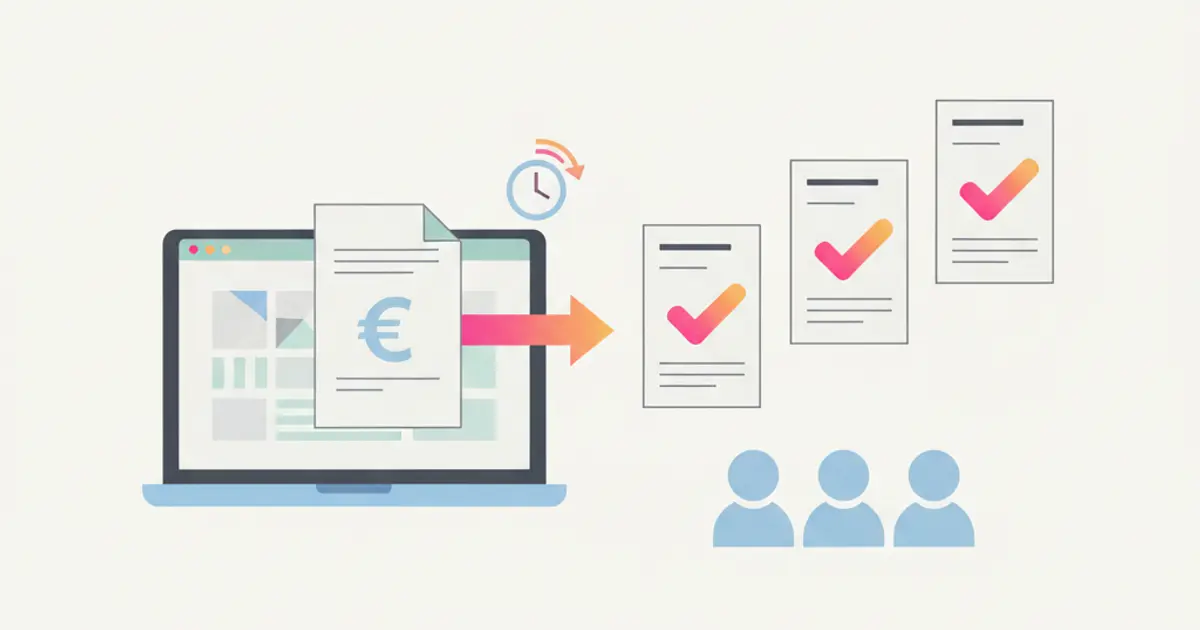
Managing contract renewals comes down to three things kept in the same place: a list of every live contract with its end date and the renewal terms you agreed, a reminder that fires weeks ahead instead of the day before, and one named person responsible for that date. When the three live together, a renewal becomes a prepared conversation instead of something you find out about afterwards. When they are missing, the first sign that a contract has run its course comes from the customer, or from nobody at all while the charge keeps running unconfirmed.
If you currently keep the fees in your head and the dates scattered across email, shared folders and a spreadsheet only one person updates, by the end of this guide you will have a single renewal list, a reminder schedule that runs on its own and a different way of handling each type of contract.
What you need before you start
- The full list of live contracts, one per row, including the ones you have not invoiced for months but that are still formally open. If you think you have thirty and can only name twenty five, that is the problem to solve first.
- For each one, the start date and the end date. They are two separate fields and you need both: the first to work out anniversaries and periods already invoiced, the second to trigger reminders.
- The renewal terms written in the contract: it continues unless somebody says otherwise, or it has to be confirmed each time. Copy the wording from the document, not from the memory of whoever signed it.
- The amount and the billing frequency: monthly, quarterly, annual. If you already issue recurring invoices you have this ready; if you still work by hand, start from how to set up automatic invoicing in a small business.
- A named owner for every contract. "Sales looks after it" is not an owner, it is a polite way of saying nobody does.
- The signed document reachable in seconds from the customer record, not from a shared folder three levels deep with two versions under the same name.
| Type of commitment | What comes up | When to start moving |
|---|---|---|
| Fixed monthly fee | the billing period | two weeks ahead |
| Annual fee | the whole year | two or three months ahead |
| Project contract in phases | the current phase | halfway through the phase |
| Renewal with a price increase | the amount, not the term | before any other conversation |
The timings in this table are working margins, meaning the time you need to prepare the proposal and speak to the customer. Any notice periods are a different matter and are written in the contract: read them there, case by case.
Step 1: pull every contract into one list
Open your CRM and build a view for live contracts, filtering customer records by the status of the relationship. If no such view exists yet, start a temporary list with six columns and nothing more: customer, subject, start date, end date, amount, owner. When you finish you will have a reliable number for the first time, namely how many contracts you actually have open.
Add a "renewal type" column with only two possible values, for example "continues unless notified" and "confirmed each time". Two values, not five: the contractual nuances belong in the document, here you only need to know whether the customer must be contacted or not. The expected result is that every row carries one of the two values and none is left blank.
Link every row to the signed document. Attach the PDF to the customer record or drop in the link, so that whoever opens the row sees the contract without asking anyone. If you run a client portal in your CRM, the same document can sit on the customer side too, and questions of the "what did we sign" kind stop arriving by email.
Step 2: make reminders fire before you need them
Set an automatic reminder tied to the end date on each row, not a generic recurring calendar entry. The reminder has to open on the right record and say what to do, otherwise it turns into a notification people dismiss without reading. Automations exist for exactly this: you set them once and they create the task when the moment comes.
Pick two moments, not one. The first is for you, to decide what to propose; the second is for the conversation with the customer. For an annual fee, an internal check two or three months out and the real contact about a month later works well. For a monthly fee two weeks is enough. At this point every contract has two dates of its own in somebody's calendar.
Assign each reminder to a person, not to a shared mailbox. A date owned by info@ is a date owned by nobody. If the owner changes, change the assignee on the row: it is the same logic you use when a quote belongs to the person who wrote it.
Step 3: prepare the renewal the way you prepare a quote
Put the renewal on a document, even when the contract continues by itself. One page with the new period, what it covers, the amount and the date it starts from. You do not need it as a formality, you need it because it is the only way the customer arrives at the renewal knowing what is being renewed. If you have no format of your own yet, start from the structure in how to write a quote and strip out what does not apply.
Reuse last year's document instead of rewriting it. Duplicating the previous proposal and updating dates and figures costs ten minutes and keeps the language consistent over time. It is the same principle behind not rebuilding every offer from scratch, which I covered in managing quotes without spreadsheets.
Send the proposal and schedule the follow-up at the same moment. A renewal proposal with no follow-up date joins the queue of every other email: the method is in how to follow up on a quote. When this step is done, every expiring contract has a document sent and a date when somebody gets back in touch.
The fixed recurring fee
This is the simplest case, which is why it gets neglected. An identical amount every month starts no conversation, so it rolls on year after year with nobody looking at it.
Book a review by calendar, not by event. Once a year, always in the same month, open the list of fixed fees and answer two questions for each: is the service delivered still the one described in the contract, and is the customer actually using it. If the second answer is no, you have found a cancellation that will arrive in six months and you can get ahead of it.
Keep the fee and the extras apart. Work outside the fee should be invoiced separately and stay recognisable: looking at the yearly spend, the customer should see at a glance how much is fee and how much is additional work. If the extras disappear into the fee, you have nothing to show the first time price comes up.
The project contract that renews in phases
Here no date expires, a piece of work finishes. The risk is the opposite of the recurring fee: not that nobody notices, but that the work carries on before the next phase has been approved.
Give phases an end date too, not just the project as a whole. A phase without a date never ends, it slips until somebody complains. Flusia handles projects with the work broken into parts and hours attributed to each one, which is what makes a phase readable.
Define what closes a phase, in one line written with the customer at the start: a document delivered, a test passed, a formal sign-off. The expected result is that the start of phase two is not a matter of opinion.
Line up the phase closing, the invoice and the proposal for the next phase. Three actions in the same moment, not three separate ones: this is when the customer is most willing to talk about what comes next, because they have just seen a result.
If the next phase does not start, close the project instead of leaving it open. A project suspended for six months clutters the list and hides the real ones. Close it, record why, and put it into a re-contact route: the method is the same as in how to win back inactive customers.
The renewal with a price increase
An increase is the variant where operational work matters most, because a different figure needs an explanation and the explanation needs preparation.
Decide the increase across the whole book before you open the first conversation. One criterion applied to everybody can be explained in a line, while a percentage decided customer by customer becomes a different negotiation every time and, sooner or later, two customers compare notes and find two different numbers.
Communicate the increase in advance and separately from the renewal. The notice first, the proposal with the new amount afterwards. Putting both in the same message pushes the customer to read only the figure.
Bring the record of the period just closed. Hours worked, requests handled, things added along the way without being billed. An increase accompanied by a list of facts is a conversation; the same increase without that list is a one way announcement.
Cancellation and the days before the end date
The period before an end date is where most contracts are lost for organisational reasons: nobody called, nobody knew they were supposed to.
Look at the contracts ending in the next ninety days once a week. Ten minutes on a Monday morning. It is the one habit in this article you cannot automate, because it needs a person deciding where to step in.
If a cancellation notice arrives, record it on the customer record the day you receive it, with the date and the channel it came through. A cancellation sitting in a personal inbox is a cancellation nobody else can reconstruct.
Treat the final days as a handover, not as a rescue attempt. What gets returned, which accesses close, what documentation you deliver, how long the history stays available. If the customer has a private area, that is the natural place to leave documents and history they can still consult afterwards.
Record the reason in a field, not in a free text note. Price, service, change of contact, need no longer there, moved in house. After ten cancellations that field tells you something no personal impression would. And a customer who leaves well can be approached again in a year.
What your contract says about notice, form of communication and continuation is in the text you signed: this article is about organising the work around those clauses, not interpreting them.
Alternative method: start from the billing calendar
If the signed documents are hard to track down while the recurring invoices all sit in your billing system, starting from the contracts means an archive job you may not have time for right now.
Export the recurring invoices of the last twelve months and group them by customer and amount: every group repeating at the same cadence is a live commitment, even if you cannot find the contract. Reconstruct the end date from the first invoice in the cycle and treat it as provisional until you recover the document.
The upside is that you start from data you already have. The limit is that you see what you bill, not what you promised: live contracts not yet invoiced stay out of the picture.
Common mistakes
Keeping the renewal list in a spreadsheet only one person updates. It works until it does not, and the month it fails is the month that person is on holiday and two renewals go by unnoticed. The test is not which tool you use, it is how many people can read and update the same list.
Contacting the customer on the end date. Arriving at the last minute removes the room to discuss anything and turns a routine renewal into a rushed decision. Even a proposal identical to last year's should go out with weeks to spare.
Renewing without checking what was actually used. Repeating the same amount for a service the customer no longer uses is how you prepare a cancellation further down the line. Better to notice early and propose a different scope.
How long it takes
Building the list of live contracts takes half a day to two days depending on how scattered the archive is: the long part is not filling in columns, it is finding the signed documents. Setting reminders and assigning owners is a couple of hours. The weekly review costs ten minutes.
The natural next step is connecting the renewal list to invoicing, so a confirmed renewal produces the document without a second manual entry: the method is in automatic invoicing for small businesses.
These are general notes on organising the work: for the clauses in your contract, the notice periods and the form of any communication, speak to your own adviser.
Frequently asked questions
How far ahead should you start working on an annual renewal? In practice two or three months ahead for the internal check, and about a month ahead for contacting the customer. Those are margins you need to prepare figures and a proposal, and they have nothing to do with notice periods, which are whatever the contract says.
Do you need dedicated contract software or is a CRM enough? If you have a few dozen contracts, all you really need is an end date, an owner and the attached document on every row: a CRM that handles customers, offers and reminders covers it. The difference starts to show past a hundred rows with different terms on each.
How do you stop a recurring charge after the relationship ends? By having the same person who records the ending also close the billing cycle, in the same moment. When the two actions sit in different hands on different days, sooner or later one happens without the other.
Share this article
Written by
Luca Bosso
Founder of Flusia
Related articles
Managing Quotes Without Spreadsheets: A Practical Guide
How a small business can run quotes properly: the fields that matter, shared statuses, automatic follow-ups and a clean handover from quote to invoice.
How to Follow Up Trade Show Leads After the Event
How to follow up trade show leads from the drive home to the first call: import them without duplicates, qualify them, assign owners and reply on time.
How to Win Back Inactive Customers
How to win back inactive customers in six steps: how to define them, how to split them by value, what the first message says and when to stop chasing.