How to Follow Up Trade Show Leads After the Event
How to follow up trade show leads from the drive home to the first call: import them without duplicates, qualify them, assign owners and reply on time.

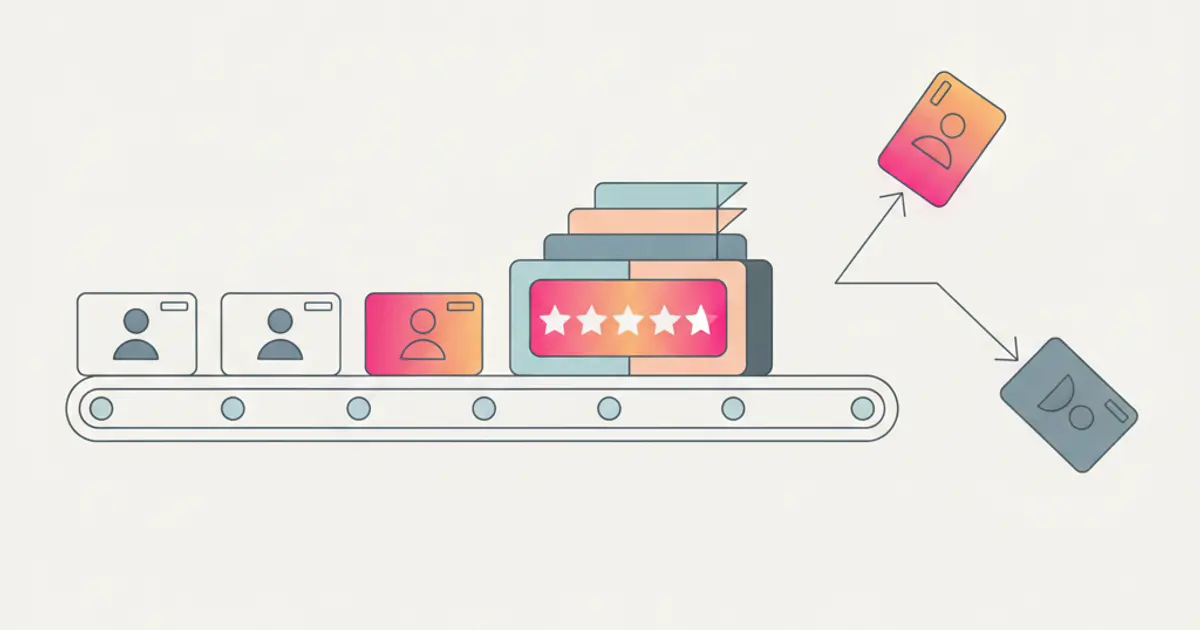
Trade show leads are handled in four moves: you load them all into your customer list within two working days of getting back, you split them into three priority levels using what you wrote at the stand, you assign each one to a named person, and you reply to the hottest ones before the week is out. Anyone not ready yet is neither binned nor chased pointlessly: they go into a slow track of newsletters and scheduled reminders.
If you have ever found an envelope of business cards from an October show in a drawer in March, by the end of this guide you will have a full path from scanned badge to first meeting booked, with an owner and a deadline at every step.
What you need before you start
- The export from the badge scanner provided by the event organiser. Ask in advance what format it arrives in and who receives it: it often lands in the inbox of whoever signed the stand contract, and stays there.
- The business cards and handwritten notes, in one container rather than three pockets of three jackets.
- A "source" field in your customer list, filled with the same value for every contact from that event, for example
Trade Show September 2026. Without it, in six months nobody can say what the show returned. - One person responsible for the follow-up, accountable for everything being loaded on time.
- Half a day blocked in the calendar before you leave, on the first or second working day after the show. Block it once you are back and it never happens.
- A duplicate matching rule already agreed, usually the email address or the VAT number.
What to write down at the stand, while the person is in front of you
A business card with no context is a piece of cardboard. Name and company you can always recover; the only thing that really matters, the reason that person stopped, lives in your head and lasts about two hours.
Write down three things for every contact, right after they walk away: the problem they described, their role in the decision and a time reference. Three crooked lines on the back of the card will do: "spare parts for the cutting line, decides himself, budget from January" saves you half an exploratory call a week later.
Add a priority letter next to the note. A for a concrete problem with a date, B for interested but no urgency, C for someone who picked up a brochure and walked on. At the stand you assign it in two seconds; at your desk you never assign it at all.
If you use the organiser's badge scanner, use its notes field too, since it almost always allows a free comment when scanning. The expected result is a file holding not just names and companies, but what you discussed.
Back at the office: loading the leads without duplicates
While the contacts live on one person's laptop, for the company they do not exist.
- Merge the sources into one sheet before you touch the CRM. Scanner export, transcribed cards and colleagues' notes go into a single file, one row per contact: you should end up with as many rows as people you met, not three partial lists.
- Add two columns the original file does not have:
source, with the event name always written the same way, andpriority, with the letter A, B or C, taken from the notes if you did not assign it earlier. - Normalise emails and phone numbers: lower case, country prefix, no spaces. Five minutes in the spreadsheet, half an hour of manual fixes if you leave it until later.
- Sort by email and check for duplicates inside the file. Two colleagues from the same company who came by at different times are not a duplicate: they are two contact people on the same company record.
- Set the duplicate rule before you confirm the import, choosing to update existing records rather than create new ones: it stops a long standing customer appearing twice, the second time labelled "trade show contact". The full procedure is in the guide on how to import your customer list into a CRM.
- Load a test batch of ten rows first, deliberately including one contact already in the system and one with accented characters in the name, then check the records created one by one.
- Import the rest and check the count. New plus updated records should match the rows in the file: if the number does not add up, something landed in the wrong field.
- Record where each contact came from and on what basis. A badge scanned at the stand, a card handed over in person and an address copied from the exhibitor directory are not the same thing, and the difference belongs on the record rather than in someone's memory. For an official reference, start from your data protection authority.
Qualifying the leads and deciding who to answer first
The number you bring home from a show, "two hundred and thirty contacts", is not a useful figure. The useful one is how many have a problem you can solve, and a moment when they will solve it.
| Level | How you recognise it | Who handles it | By when |
|---|---|---|---|
| A | explicit problem, decision making role, stated timing | assigned rep, phone call | 2 working days |
| B | real interest but no urgency | assigned rep, personal email | 5 working days |
| C | general curiosity, took a brochure and left | nobody in particular, automated track | within 2 weeks |
| Out of scope | sector or size you do not serve | nobody | never, but stays on file |
The rows worth discussing are the last two. Out of scope contacts are not deleted, because a year from now you risk buying them back as a cold list without knowing you ruled them out: flag them and take them out of sales flows. C contacts do not deserve a call each, but they deserve something.
To make that classification less dependent on the mood of whoever does it, score two or three objective signals instead of an impression: the reasoning and example rules are in the guide on automatic lead scoring.
Splitting the leads between your sales reps
The distribution rule has to be agreed before the show, so nobody negotiates on the way back. Three rules work well in a small business.
By territory, if your reps already work by area: each contact goes to whoever covers the company's region. The clearest rule, and the least argued about.
By who met them at the stand, if you kept track of the shifts. The person speaks to someone who remembers them, but whoever worked the busy day gets three times the work.
Round robin on the A contacts, by territory on B and C, the common compromise when a show brings many hot contacts from few regions.
Whichever rule you pick, put a pick-up deadline next to it: a lead assigned and untouched for five days goes back into the pool. Without that, the rule is just a list of names. The distribution models, including what happens when nobody picks a lead up, are in the guide on how to assign leads to your sales team.
One detail that always gets forgotten: an existing customer goes straight to their rep, not into the new lead pool.
The follow-up in the first days
Send the first message within two working days of getting back, not on the day the show closes: the Monday after a show, inboxes are full of identical messages from every exhibitor, while on Wednesday yours lands when the person has time.
Write one line that proves you were there too. Not "thank you for visiting our stand", but "you mentioned the downtime on the cutting line, here are the two cases I described". If the stand notes reached the CRM, that line takes thirty seconds, and the expected result is a reply, not an open.
For A contacts phone, and use email only as a reminder. A call after three days beats any email, while a call after ten days is worth less than an email after three.
If you collected mobile numbers, consider the channel the person actually uses. A short message on business WhatsApp, sent from the company number rather than a rep's personal one, gets answers in many sectors where email does not. How to set it up without turning it into an anonymous blast is in the guide on sending WhatsApp messages to multiple customers.
Record the outcome of every attempt, including the negative ones. "No answer" written three times is information; remembered, it is not. The practical rule: three attempts over two weeks, then the status changes.
The long follow-up, for people who are not ready yet
Most trade show contacts will not buy in the next two months. That does not make them useless, it makes them early: the right moment arrives when nobody is looking.
The long track has three ingredients and none needs recurring manual work. The first is a list dedicated to the event, kept apart from your other subscribers for at least a year, because what you send to someone who met you at a show can be far more specific. The second is a short sequence of useful emails, not promotional: three or four sends over two months, each with something concrete, a spec sheet, a use case, the answer to a question ten people asked at the stand. How to build it is in the guide on email marketing and newsletters from your CRM.
The third is a dated reminder, the most underrated. If someone told you at the stand "let's talk again in January", the only way that happens is a scheduled task on the record with the right date and the name of whoever has to do it.
At six months it makes sense to run a dedicated pass on people who never replied, with a message that acknowledges the time passed. The criteria for choosing who is worth picking up are in the guide on how to win back inactive customers.
Alternative method: loading leads from your phone during the show
If the show runs three days, waiting until you are back means losing half the context. The alternative is to load contacts as you go, from your phone: as soon as the person walks away you open the CRM in the phone browser, create the record with name, company and email, and type the three lines of context into the notes field. Thirty seconds per contact.
The real advantage is not the time saved afterwards, it is the quality of the notes: what you write two minutes after the conversation is a different thing from what you reconstruct the following Tuesday.
The drawback is that on a crowded stand you will not do it. The realistic method is mixed: phone records for the A contacts, bulk import on return for the rest. Agree the two or three mandatory fields first, or you end up with forty records written in forty ways.
Common mistakes
Sending everyone the same email the day after the show closes. One generic send to two hundred addresses arrives alongside every other exhibitor's and says nothing the recipient does not know. The fix is not two hundred different emails: it is separating the A contacts, who get a personal message, from the rest, who get a group send built on the theme of the show.
Loading the contacts without the source field. This is the mistake you pay for a year later, when somebody asks whether the stand is worth repeating and nobody can answer. The fix costs ten seconds: one column, one consistent value.
Leaving the cards with whoever collected them. As long as they stay in the owner's jacket or a rep's phone, the company has paid for a stand to enrich a personal address book. The fix is the deadline: two working days, one person accountable.
How long it takes and what comes next
For a show that brings between one hundred and two hundred and fifty contacts, the work on return usually takes three to five hours: an hour to merge and clean the sources, half an hour for the import, an hour for qualification and assignment, the rest for the first messages to the A list.
The next step, once the leads are in and assigned, is to close the loop: what happens to a lead who does not reply, after how many attempts the status changes, who checks nothing is sitting still. The full path is in the guide on managing leads without losing them.
The points on consent and on handling data collected at a show are general: for your specific case, check with your own adviser and with the guidance published by your data protection authority.
Frequently asked questions
How quickly should a trade show lead be contacted? For anyone who described a concrete problem at the stand, within two working days of getting back. For the others the window stretches to about ten days, provided the message refers to something specific: a relevant message after a week beats a generic one sent the same day.
Can business cards be thrown away once they are loaded? Yes, but only after checking that the data in the CRM is correct and legible. Many people photograph them and keep the images for a few months as a backup, especially when transcription was rushed.
What do I do with contacts who never answer any attempt? After three attempts over two weeks their status changes: they leave the reps' task lists and enter the slow track of newsletters and scheduled reminders. They are not deleted and not called again: some resurface on their own.
Is it worth loading contacts who are clearly out of scope? Yes, but flagged as such and removed from sales flows and sends. The value is institutional memory: it stops someone spending time a year later on a name already ruled out.
Share this article
Written by
Luca Bosso
Founder of Flusia
Related articles
How to Assign Leads to Your Sales Team
How to assign leads to sales reps without arguments: the four distribution rules, what happens when nobody picks a lead up, and the one number to track.
How to Send Facebook and Instagram Leads to a CRM
How to get Facebook and Instagram lead form submissions into your CRM automatically: connecting the Page, mapping the fields and tracking the campaign.
How to Manage Leads Without Losing Them: 7 Mistakes Costing Your SME Sales
Discover the 7 most common lead management mistakes and how a structured CRM can help your SME stop losing sales opportunities.