Answering Clients on WhatsApp at 3 AM? There's a Better Way
Learn how to integrate WhatsApp into your CRM with an AI Agent that responds 24/7, keeps full history and frees up your time.

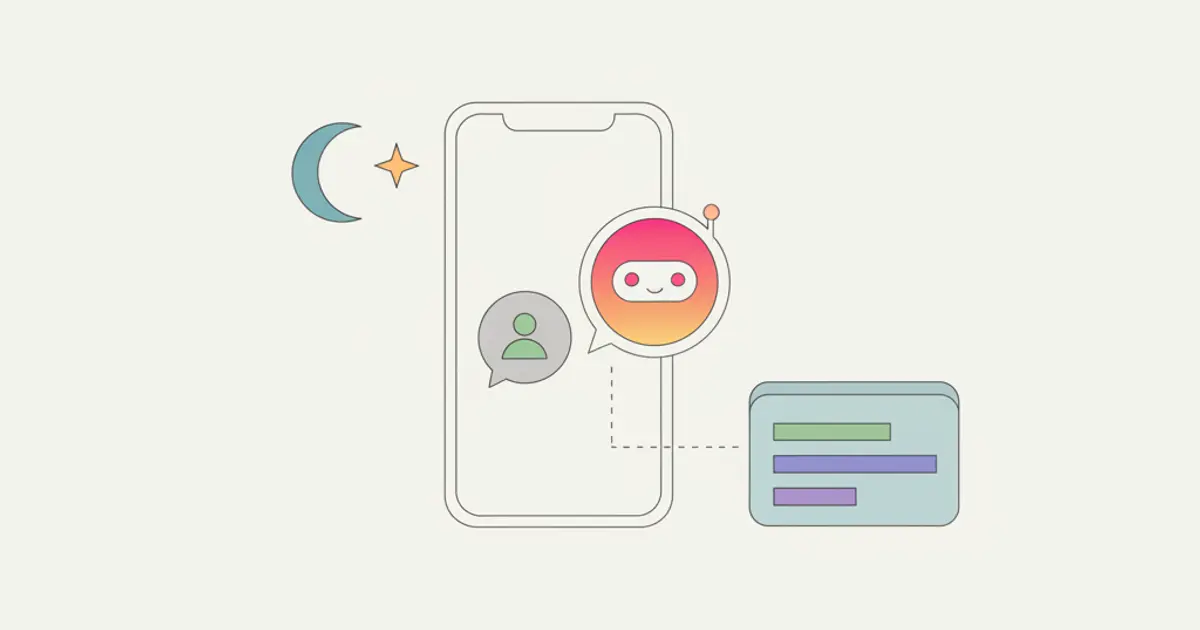
It is 11:47 PM. You are about to fall asleep and your phone buzzes. A client writes on WhatsApp: "I need to know the status of my order." You reply on the spot because if you do not, you will forget by morning. At 6:30 AM another message lands: "How much does the premium service cost?" And the day has not even started.
WhatsApp has become the number one communication channel for SMEs. Clients prefer it over email, phone calls and even website forms. The problem is that WhatsApp was never designed to manage business relationships. Messages get lost among personal chats, there is no way to assign a conversation to a colleague, and the entire history lives only on your phone.
There is a better way. One where WhatsApp becomes a professional channel integrated into your CRM, with an AI assistant that responds when you cannot, and does it well.
WhatsApp as the primary channel for SMEs
The numbers speak for themselves. WhatsApp has over 35 million active users in Italy alone, and across Europe and Latin America the platform dominates business communication in similar fashion. Your clients are on WhatsApp every day, chatting with friends, coordinating with family, and increasingly expecting to interact with businesses there too.
The reason clients prefer WhatsApp is rooted in its nature: immediacy, informality, and familiarity. Sending a WhatsApp message feels effortless compared to composing a formal email or navigating a website's contact form. The expectation of a quick reply is built into the medium, which is both its greatest strength and its biggest challenge for your business.
Consider the open rates: WhatsApp messages are read 98% of the time, compared to roughly 20% for marketing emails. That is not a small difference: it is a fundamentally different level of engagement. When you send information via WhatsApp, it gets seen. When you send it via email, it probably does not.
Yet most SMEs use WhatsApp in the most primitive way possible: the business owner's personal phone. Messages mix with personal conversations. When the owner is busy, nobody else can respond. There is no backup, no searchable history, and no connection to any other business system. The client data lives in a chat thread that could be accidentally deleted tomorrow. If this sounds like your situation, you are far from alone, and far from stuck.
The limits of standard WhatsApp Business
WhatsApp Business was a step forward, but it was designed for very small operations: a single shopkeeper or a freelancer handling a manageable volume of messages. For any team that has more than one person handling client communication, the limitations become painful quickly.
The multi-device restriction means that at most four devices can access the same account simultaneously. For a team of five or more, someone is always locked out. There is no way to assign a conversation to a specific team member, which means either everyone reads everything (chaotic) or only one person handles WhatsApp (a bottleneck and a single point of failure).
There is no integration with your CRM, project manager, or invoicing system. A client sends you their billing details via WhatsApp, and someone needs to manually copy that information into another tool. A prospect asks about pricing, and the salesperson switches to the CRM to look up the details, then switches back to WhatsApp to reply. Every context switch is lost time and an opportunity for error.
Broadcast campaigns are capped at 256 contacts, far too few for any serious marketing or newsletter effort. Labels exist but offer only basic categorization with no automation behind them. And perhaps most critically, there is no real conversation history linked to a client profile. If you want to know everything a specific client has ever discussed with your company, you have to scroll through a chat thread manually.
The AI Agent that responds 24/7
This is where everything changes. An AI Agent integrated into your WhatsApp channel acts as a knowledgeable first responder: available 24 hours a day, seven days a week, never tired, never in a bad mood, and never on vacation.
The AI Agent is not a simple chatbot with pre-programmed responses. It is connected to your company knowledge base: your product catalog, your pricing, your FAQ, your service descriptions. When a client asks "How much does the premium plan cost?" the AI Agent pulls the current pricing from your system and responds accurately. When someone asks "What are your opening hours?" or "Do you ship internationally?" the answer comes instantly, without any human needing to intervene.
The power lies in knowing its own limits. When a question is too complex or too sensitive for automated handling (a complaint, a specific negotiation, a technical issue that requires human judgment), the AI Agent performs a smart handoff. It tells the client that a team member will follow up shortly and simultaneously notifies the right person on your team, providing them with the full conversation context. The client never feels abandoned; the team member never starts from zero.
The tone of voice is fully customizable. You define whether the agent should be formal or friendly, technical or conversational, brief or detailed. It adapts to your brand identity so that clients feel like they are talking to your company, not to a generic bot. Over time, as you review conversations and refine the knowledge base, the agent becomes increasingly accurate and natural.
For businesses that receive a high volume of repetitive questions (and most SMEs do), the AI Agent can resolve 60-80% of incoming inquiries without human involvement. That means your team focuses on the conversations that actually need a human touch, while routine questions are handled instantly, even at 3 AM on a Sunday.
Automating responses and flows
Beyond the AI Agent, WhatsApp integration opens up a world of automated communication flows that work in the background to keep your clients informed and engaged.
Out-of-hours automatic replies are the simplest and most impactful starting point. When a client messages outside business hours, they immediately receive a professional response acknowledging their message and setting expectations for when they will hear back. This single automation eliminates the anxiety of unanswered messages, both for the client who wonders if anyone is listening, and for you who feels compelled to reply at midnight.
Welcome messages for new contacts create a polished first impression. When someone messages your business for the first time, they receive an instant greeting that introduces your company and guides them toward the information they need. It is the digital equivalent of a receptionist greeting a visitor, except this receptionist never steps away from the desk.
Automated follow-up sequences are where WhatsApp truly shines as a sales channel. After an initial interaction, you can schedule a series of messages (a check-in at 24 hours, additional information at 72 hours, a special offer at seven days), all personalized with the contact's name and relevant details. Combined with your sales pipeline, these sequences can be triggered by deal stage changes, ensuring that every prospect receives timely attention.
For broader communication, WhatsApp campaigns allow you to send targeted messages to specific client segments: announcing a new service to clients in a particular region, sending a seasonal promotion to past buyers, or notifying a group about an upcoming event. Unlike broadcast lists, these campaigns are managed from within your CRM, giving you full control over targeting, timing, and tracking.
You can even automate the sending of documents, quotes, and order confirmations via WhatsApp. A client requests a quote, and within minutes they receive it directly in their WhatsApp: no email to check, no attachment to download, just the information they need in the channel they prefer.
Full conversation history in the CRM
One of the most transformative aspects of WhatsApp-CRM integration is that every message, in every conversation, is permanently linked to the client record. This means that when you open a contact's profile, you see the complete timeline of interactions: emails, WhatsApp messages, phone call notes, meeting summaries, everything in chronological order.
The practical implications are enormous. When a colleague needs to take over a client conversation (because the primary contact is on vacation, in a meeting, or has left the company), they have full context from the first message. No awkward "Can you remind me what we discussed?" moments. No lost information. No client having to repeat themselves.
Full-text search across all WhatsApp messages means you can find any conversation in seconds. "What did that client say about the delivery date?" Type a keyword, find the exact message, get the answer. For businesses dealing with hundreds of client interactions per week, this searchability is not a luxury: it is a necessity.
Every attachment and media file sent through WhatsApp is saved in the contact profile, accessible to anyone with the appropriate permissions. Photos of a product issue, signed documents, voice messages: all organized and retrievable without scrolling through endless chat threads on a phone.
There is a less obvious reason to keep conversations in the company system rather than on the phone of whoever replies: when somebody leaves the team, the memory of those deals leaves with their device. The functions that let several operators work on the same number, with permissions and history that stay with the business, are described on the business WhatsApp for teams page.
Analytics and metrics
What gets measured gets managed, and WhatsApp communication is no exception. When your WhatsApp channel runs through a CRM, you gain access to analytics that are impossible with standard WhatsApp Business.
Average response times per operator show you who is responding quickly and who needs support. When you know that one team member replies in two minutes on average while another takes two hours, you can address the gap before it affects client satisfaction.
Message volume by day and hour helps you plan staffing. If 60% of your WhatsApp messages arrive between 9 AM and noon, that is when you need your best communicators available, and when the AI Agent is most valuable for handling the overflow.
The AI Agent resolution rate, the percentage of conversations resolved without human intervention, is a key efficiency metric. Tracking it over time shows whether your knowledge base is improving and where new content is needed.
Perhaps most powerfully, you can link WhatsApp conversations to deals. When a chat leads to a sale, you can trace the entire journey from first message to closed deal. This data reveals which types of conversations generate revenue, which messaging approaches work best, and how WhatsApp compares to other channels in your lead management process. Weekly reports generated automatically give you and your team the insights needed to continuously refine both the AI Agent's performance and your overall communication strategy. Over time, these insights feed into your broader business intelligence, helping you make smarter decisions across the board.
Share this article
Written by
Luca Bosso
Founder of Flusia
Related articles
WhatsApp Multi Agent: One Shared Number for Your Team
How several people can answer from the same business WhatsApp number: chat assignment, internal notes, roles and a shared history inside your CRM.
WhatsApp as a Sales Channel: It's Not Just Customer Support
WhatsApp isn't just customer service: learn how to use it as a sales channel with automations, AI agents and CRM integration to qualify leads and close deals.
CRM Newsletters: How to Send Your First Campaign
How to send a newsletter from your CRM: authenticate your sending domain, build a segment, write and test the email, schedule it and read the results.