The Future of CRM: AI, Automation and Why 2026 Is the Turning Point
2026 CRM trends: conversational AI, end-to-end automation, CRM as a business operating system. Discover what will change in the next 2 years.

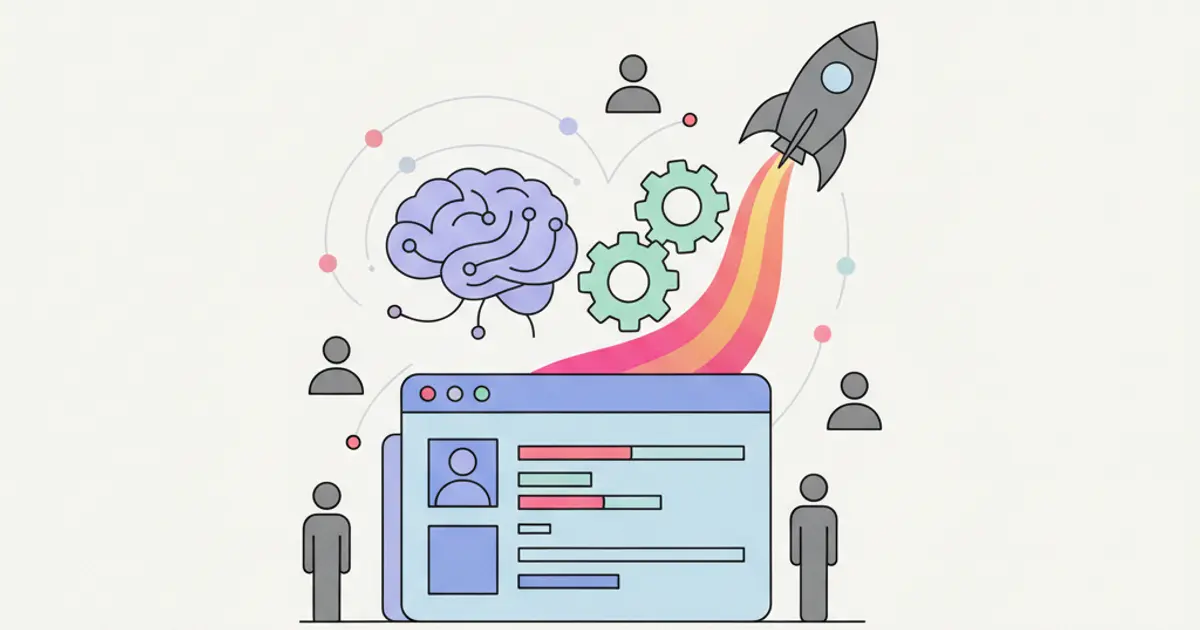
The CRM as you knew it is dying. Not the concept of managing customer relationships — that is more alive than ever. But the rigid tool where you enter data, look at reports, and hope the team actually uses it? That has its days numbered. 2026 is the year when artificial intelligence stops being a buzzword in press releases and becomes a feature you use every day without even thinking about it.
What is happening in the CRM world resembles the transition from landline phones to smartphones. The landline made calls, period. The smartphone does everything else and, incidentally, also makes calls. In the same way, the CRM of the future is not just a contact database with a pipeline — it is the operating system of your business, where sales, projects, communication, and administration converge into a single intelligent flow.
If you manage a company or a sales team, understanding these trends is not a theoretical exercise — it is a strategic decision. Those who adopt tomorrow's technologies today will have a competitive advantage that becomes increasingly difficult to close. Let us see what lies ahead.
The Trends Redefining CRM in 2026
The most significant shift happening right now is convergence. For years, businesses have operated with a fragmented technology stack: one tool for CRM, another for project management, a third for team communication, a fourth for invoicing. Each tool does its job reasonably well in isolation, but the gaps between them create information silos, context switching costs, and integration headaches that consume an enormous amount of organizational energy.
The CRM of 2026 absorbs these functions into a single platform. Sales, project delivery, team communication, invoicing, and customer service live in the same environment, connected by shared data and shared context. When a deal closes, the project kicks off automatically. When a milestone is reached, the invoice generates itself. When a client messages on WhatsApp, the conversation appears in the same interface where the team manages deals and tasks. This is not a futuristic vision — it is happening now, and the businesses that embrace it are pulling ahead of those still juggling five disconnected tools.
AI as co-pilot is the second defining trend. The role of artificial intelligence in CRM is not to replace the sales rep or the project manager — it is to empower them. AI handles the repetitive, data-heavy work that humans find tedious: scoring leads, drafting emails, transcribing meetings, generating reports. The human focuses on what humans do best: building relationships, making nuanced judgments, and closing deals. This partnership between human intuition and machine efficiency is where the real competitive advantage lies, and our guide on AI in CRM covers ten specific ways this plays out in practice.
Privacy by design has evolved from a regulatory checkbox into a genuine competitive differentiator. In a world where data breaches make headlines and consumers are increasingly privacy-aware, a CRM that demonstrates robust data protection practices earns trust that translates directly into client retention and referrals. Companies that treat privacy as a feature rather than a burden are discovering that it strengthens rather than constrains their business.
Conversational AI: Talk to Your Data
The way you interact with your CRM is changing fundamentally. The traditional approach — navigating through menus, clicking through filters, configuring report parameters — is giving way to natural language interaction. Instead of "click Report, then Sales, then This Month, then Filter by Region," you simply ask: "How much did we sell this month in the northern region?"
This shift sounds incremental, but its impact is profound. It democratizes data access across the entire organization. Previously, getting insights from the CRM required either technical proficiency with reporting tools or access to someone who had it. Now, anyone on the team can ask a question and get an instant, accurate answer. The sales rep who wants to know their pipeline status, the manager who needs a margin breakdown, the CEO who wants a revenue comparison — all of them get answers in seconds, in plain language, without training or technical intermediation.
Predictive analytics takes this further. The AI does not just answer your questions — it anticipates them. "This deal has a 73 percent probability of closing based on historical patterns, but it has been in the current stage longer than average, which suggests you should schedule a follow-up this week." These proactive insights transform the CRM from a passive record-keeping system into an active strategic advisor that helps the team make better decisions in real time.
Meeting transcription and analysis represent another dimension of conversational AI. Client calls are recorded, transcribed automatically, and analyzed for key decisions, action items, and sentiment shifts. The output feeds directly into the CRM record, so the deal history includes not just what happened but what was said and what was agreed. The paradigm is shifting from "the team enters data into the CRM" to "the CRM captures data for the team" — a reversal that solves the adoption problem that has plagued CRM implementations for decades.
End-to-End Automation: The CRM That Works on Its Own
Automation in CRM has existed for years, but it has been limited to simple trigger-action sequences: "if a lead submits a form, send a welcome email." The automation of 2026 is fundamentally more sophisticated. Intelligent workflows evaluate context before acting. When a new lead arrives, the system does not just assign it to the next available rep — it considers the lead's industry, company size, language, time zone, and the rep's current workload, expertise, and historical performance with similar leads to make the optimal assignment.
Follow-up sequences are no longer rigid drip campaigns where every lead receives the same messages on the same schedule. AI-generated follow-ups adapt to the lead's behavior: if they opened the first email and clicked a link, the second message references what they looked at. If they did not open the email at all, the system tries a different channel or a different subject line. The sequence is not just automated — it is responsive, adjusting in real time based on engagement signals.
Zero-click invoicing exemplifies end-to-end automation at its best. When a deal closes in the CRM, the invoice is created automatically based on the deal's services and pricing, sent to the client, and reconciled with payment records when the money arrives. For businesses using integrated invoicing systems, the entire financial workflow from sale to payment happens without anyone manually creating, sending, or tracking an invoice.
The human's role in this automated environment is not diminished — it is elevated. Instead of spending time on execution, your team spends time on strategy, relationship building, and the complex decisions that require human judgment. The CRM handles the routine; the humans handle the exceptional. If you are ready to explore what automation can do for your specific processes, our guide on automatic workflows provides a practical starting point.
CRM as a Business Operating System
The end of the silo era is the most consequential trend in CRM evolution. When sales, marketing, project delivery, and administration operate in separate systems, information passes between them through manual handoffs, email threads, and meeting updates. Every handoff is an opportunity for data to be lost, delayed, or misinterpreted.
A CRM that functions as a business operating system eliminates these handoffs by bringing everything into a single ecosystem. The sales team closes a deal, and the delivery team immediately sees the scope, timeline, and client requirements — because they are working in the same system. The delivery team completes a milestone, and the finance team sees it reflected in the invoicing queue. The client asks a question on WhatsApp, and whoever responds can see the complete history of the relationship: sales interactions, project progress, payment status, and previous conversations across every channel.
This concept of a "single source of truth" — where every piece of business information lives in one place, updated in real time — sounds simple but transforms how organizations operate. Decisions are faster because the information needed to make them is immediately accessible. Mistakes are fewer because there are no discrepancies between different systems' versions of reality. Onboarding is smoother because new team members have one system to learn, not five.
Stakeholder portals extend this operating system beyond the boundaries of the organization. Clients access a dedicated portal where they see project progress and shared documents. Partners view their commissions and referral pipeline. External collaborators interact with the tasks and deliverables assigned to them. Each stakeholder sees their slice of the system, governed by permissions that ensure they access only what is relevant to them.
An API-first architecture ensures that the CRM can connect to any external tool that a specific business needs, while no-code customization capabilities allow flows, reports, and automations to be configured by business users without requiring developer involvement. The combination of a comprehensive core platform with extensibility through APIs and customization creates a system that adapts to virtually any business model.
What to Expect in the Next Two Years
2026-2027: Mass Adoption of AI in CRMs
The current year marks the transition of AI from a premium feature available only in enterprise tiers to a base capability included in all plans. Just as cloud storage went from a luxury to a given, AI in CRM is becoming table stakes. The implications for businesses that have been waiting for AI to become accessible are significant: the barriers to entry are dropping rapidly.
AI agents — virtual assistants that autonomously manage defined tasks — are the most tangible manifestation of this shift. An AI agent can handle first-line WhatsApp inquiries, qualify leads through conversation, schedule meetings, update CRM records, and generate reports — all without human intervention for routine cases. The agent knows when it is out of its depth and escalates to a human with full context, maintaining the quality of client interactions while dramatically reducing the volume of work that requires human attention.
Voice-first interaction is becoming normalized. Sales reps dictate deal updates from their car. Managers ask for pipeline reports during their morning commute. The CRM becomes something you talk to, not just something you type into. This shift is particularly significant for mobile usage, where voice input is faster and more natural than typing on a small screen.
2027-2028: The Predictive CRM
The CRM of the near future will not just record what has happened — it will predict what will happen. Churn prediction models will alert you before a client decides to leave, giving you the opportunity to intervene while the relationship is still salvageable. Dynamic pricing suggestions will recommend optimal pricing based on historical data, client characteristics, and competitive context.
Workflows will become self-optimizing, adjusting their own parameters based on results. If a particular follow-up sequence produces better outcomes when the second message is sent after three days instead of two, the system will make that adjustment automatically. Cross-platform intelligence will allow the CRM to learn from every interaction across every channel — email, WhatsApp, phone, chat, portal — building a comprehensive behavioral model that informs every automated decision.
How to Prepare: What to Do Today
The businesses that will benefit most from these trends are the ones that start preparing now, not the ones that wait until the technology is ubiquitous and the competitive advantage has evaporated.
The first step is to choose a CRM that invests in AI. Not all vendors are innovating at the same pace, and the gap between leaders and laggards is widening. Look for platforms that are actively developing and shipping AI capabilities, not ones that mention AI in their marketing but deliver it as an expensive, limited add-on.
The second step is to start with data. AI is a multiplier, but it multiplies what you feed it. The more clean, structured, complete data you have in your CRM, the more effective every AI feature will be — from lead scoring to forecasting to personalization. If your client data is currently scattered across spreadsheets and email inboxes, consolidating it into a CRM is the prerequisite for everything that follows.
Third, train the team. AI tools are intuitive but not self-explanatory. A team that understands how to use AI features — how to interpret scoring, how to review AI-generated communications, how to leverage AI insights in their sales process — will extract dramatically more value than one that ignores the features because nobody showed them how they work.
Finally, test rather than theorize. Reading about AI trends is useful for context, but the real insights come from using the tools with your actual data and your actual processes. Start a free trial, import your contacts, activate the AI features, and measure the impact. The difference between companies that thrive in the AI era and those that struggle is not knowledge — it is action.
Share this article
Written by
Luca Bosso
Founder of Flusia
Related articles
AI in CRM: 10 Things Artificial Intelligence Does for You (While You Work)
Discover 10 practical ways AI inside your CRM automates tasks, scores leads, transcribes meetings and helps your team sell smarter in 2026.
How to Record a Meeting and Get an Automatic Transcription
Discover how to record meetings on Meet, Zoom and Teams and get automatic AI transcriptions with tasks and recaps directly in your CRM.
Your Team Wastes 5 Hours a Week on Manual Tasks: Here's How to Automate
Discover which repetitive tasks drain your team's time and how workflow automation can give you back 5+ hours every week.